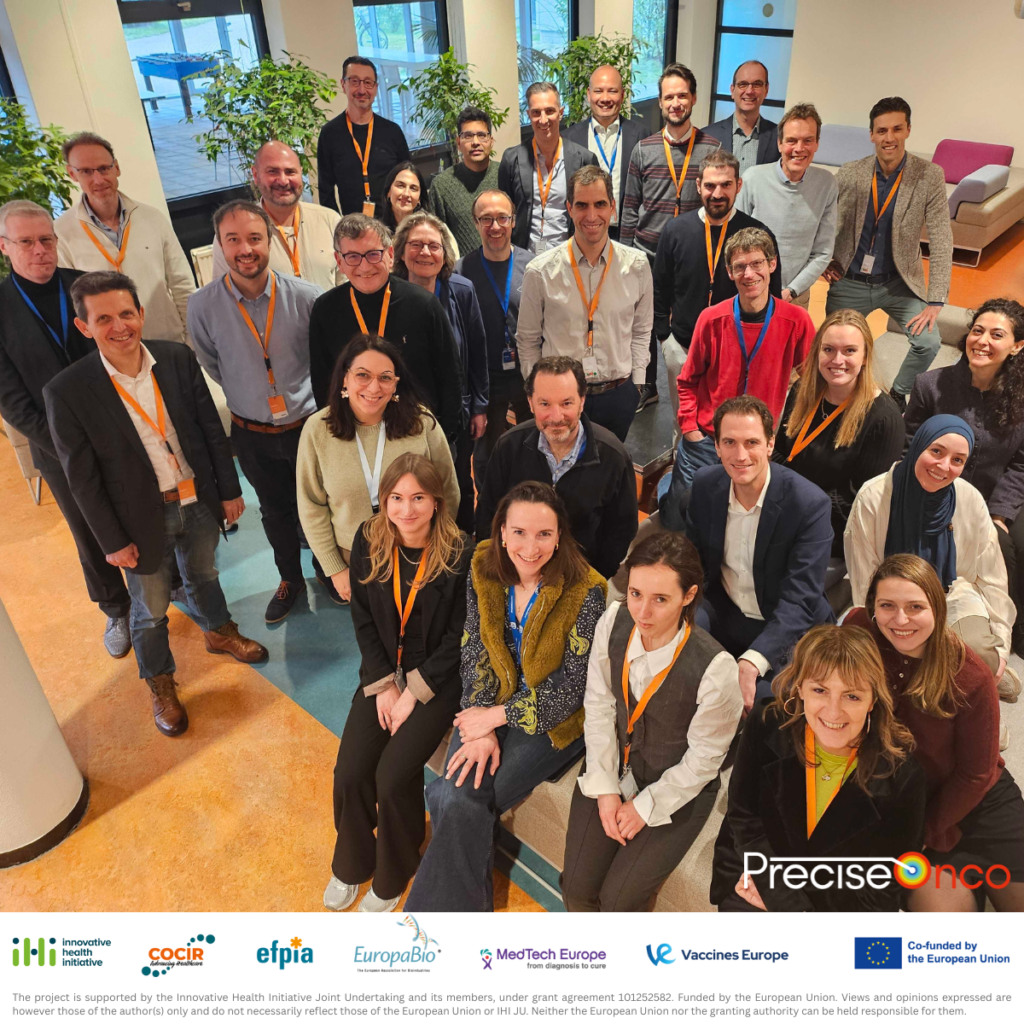
Co-funded by the EU’s Innovative Health Initiative (IHI), the research consortium will combine advanced medical imaging, robotic guidance technologies, and AI to standardize and enhance the precision of minimally invasive cancer treatments
Five-year research program with total budget of EUR 23.9 million includes five clinical studies to validate the technical solutions
Amsterdam, the Netherlands – Royal Philips (NYSE: PHG, AEX: PHIA), a global leader in health technology, today announced that the PreciseOnco consortium, coordinated by Philips, has been awarded funding from the EU’s Innovative Health Initiative (IHI) to advance precision cancer treatment through the integration of advanced medical imaging, robotic assistance, and minimally invasive therapies. The EUR 14.9 million public funding will be complemented by EUR 9 million in in-kind contributions and additional resources from industry partners, supporting a five-year research and innovation program that also includes five clinical studies.
Innovation public-private partnership
The PreciseOnco public-private partnership unites experts from industry, research organizations, medical societies and leading European hospitals:
- Industry partners: Philips, Quantum Surgical, and IGEA.
- Research organization: European Institute for Biomedical Imaging Research (EIBIR)
- Medical society: Cardiovascular and Interventional Radiological Society of Europe (CIRSE).
- Academic partners: University Hospital Cologne (Uniklinik Koeln) in Germany, University Medical Center Utrecht (UMCU) and Leiden University Medical Center (LUMC) in the Netherlands, and two major university hospital networks in France: Assistance Publique–Hôpitaux de Paris (APHP; Hôpital Henri-Mondor) and Hospices Civils de Lyon (HCL).
By uniting Europe’s leading clinical expertise and industry innovation, PreciseOnco aims to set a new benchmark for precision, safety, and efficiency in minimally invasive cancer care.
Bringing advanced technology into the interventional room
The PreciseOnco consortium aims to develop a suite of integrated technologies designed to take the next leap in precision cancer care. Central to the research and innovation program is spectral imaging, an advanced form of CT and cone-beam CT that captures significantly richer information about tissue composition than conventional imaging, enabling more confident differentiation between tumors, vasculature, and healthy tissue. By analyzing X-rays at different energy levels, spectral imaging enables physicians with greater clarity to see exactly what tissues they are treating.
To complement this advanced imaging technology, PreciseOnco will integrate robotic guidance systems that use real-time imaging data to guide interventional instruments (one or multiple needles) with sub-millimeter precision. The consortium will also look to advance electrochemotherapy, a minimally invasive technique that combines electrical pulses with chemotherapy to selectively treat cancer tissue, with the aim of maximizing tumor control while preserving surrounding healthy tissue.
Crucially, all these technologies will be powered by AI algorithms designed to enhance image quality, reduce radiation dose, streamline advanced visualization software and provide real time intra procedural feedback on treatment success. This would allow physicians to confirm that tumors have been fully treated before the patient leaves the operating room.
"Advanced imaging and robotic precision have the potential to transform cancer care. By bringing together spectral imaging, AI-powered software, and robotic guidance technologies, we aim to help physicians treat cancer with greater accuracy, confidence, and speed. This will ultimately mean better outcomes for patients, fewer repeat procedures, and more efficient use of hospital resources. The PreciseOnco consortium represents a truly integrated approach, uniting industry innovation with clinical expertise and patient insight."
Bert van Meurs, Chef Business Leader for Image Therapy at Royal Philips
Clinical studies
The project is structured into multiple work packages covering spectral imaging technology development, AI based image processing, robotic guidance integration, multi-center clinical validation, and health economic assessment. PreciseOnco will conduct five clinical studies spanning multiple cancer types and interventional workflows, ensuring robust validation in real world clinical settings:
- VISTA (Virtual Spectral Imaging for Superior Thermal Ablation Guidance): Evaluating spectral imaging to improve liver, kidney ablation procedures and liver radioembolization.
- SPOT ON (Spectral angiography-computed tomography to Optimize percutaneous Tumor ablation): Assessing spectral CT for better tumor targeting and treatment planning.
- HORA EST HCC 2: Combining thermal ablation with transarterial chemoembolization (TACE) in a single session for improved hepatocellular carcinoma treatment.
- SPECTRA-L (Spectral Performance Evaluation of a CT-Equipped Therapeutic Radiology Angio Suite in Liver): Testing spectral imaging for transarterial chemoembolization (TACE) procedures.
- LASER (Locoregional therApies Spectral Evaluation of Responses): Developing imaging biomarkers to predict treatment success across multiple cancer types and interventional techniques.
Together, these studies will generate evidence to support the adoption of spectral imaging and robotic guidance across European cancer centers, extending access to advanced minimally invasive treatments to a larger patient population.
Philips and innovation public-private partnerships
Public-private partnerships play a vital role in advancing healthcare innovation. With over 40 years of experience in shaping and leading such partnerships, Philips sees them as a powerful complement to its global R&D programs, helping build sustainable ecosystems that foster innovation. Philips’ broad imaging, image-guided therapy, and healthcare informatics portfolio helps clinicians visualize, assess, guide treatment, and confirm outcomes—supporting more precise and personalized care. With innovations like Verida detector-based spectral CT fully powered by AI and Azurion image-guided therapy system, Philips continues to push the boundaries of imaging technology, advanced visualization and minimally invasive therapy worldwide.
The PreciseOnco project website is available at www.preciseonco.eu.
The CORDIS project page for PreciseOnco can be accessed here.
References
[1] European Cancer Information System (ECIS) – jrc_CancerEstimates2022_factsheet.pdf.
[2] World Health Organization (WHO) – Global cancer burden growing, amidst mounting need for services.
[3] Global Interventional Oncology Market report – Interventional Oncology Market Size and Growth Analysis Report.